任务成功
运载器成功将载荷送入目标轨道
Akatsuki (Planet-C)
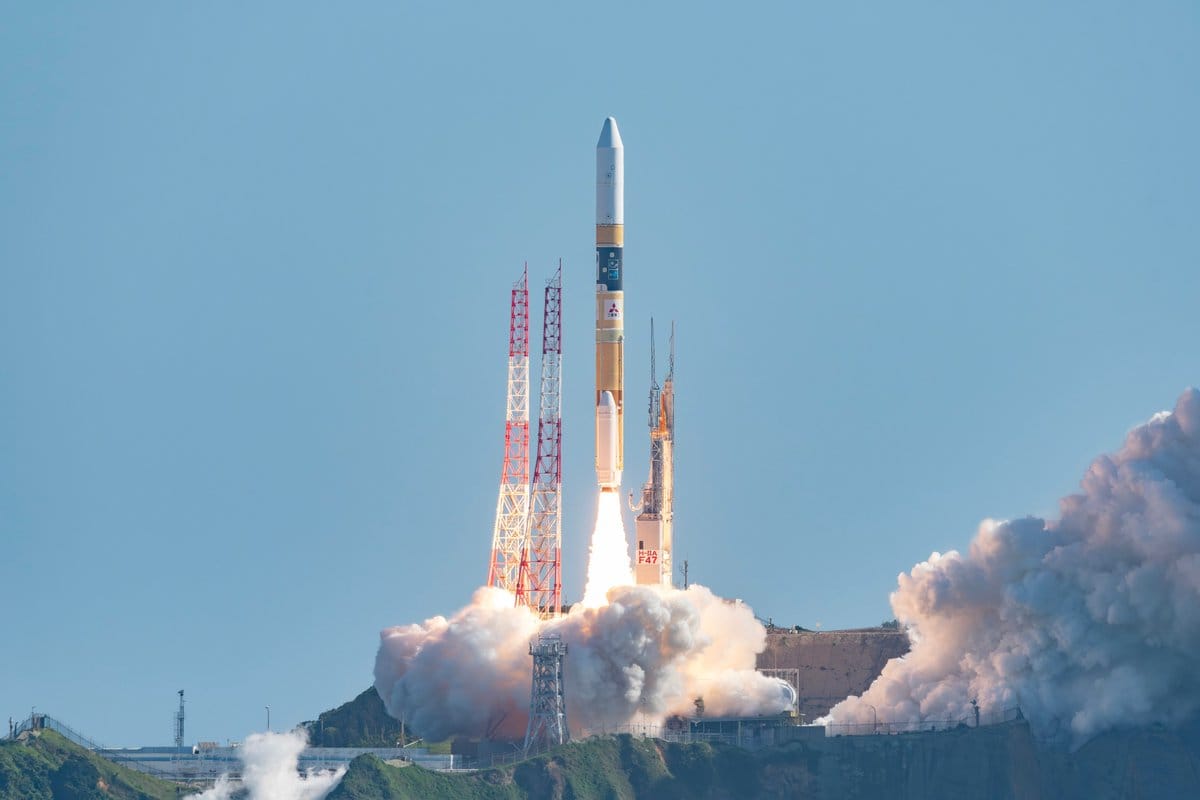
三菱重工 · H-IIA 202 · 吉信发射综合体 LP-1
任务简介
Planet-C 或 VCO(金星气候轨道器,发射后更名为 Akatsuki)是日本宇宙航空研究开发机构(JAXA)的一项任务,旨在通过多波长成像从轨道上研究金星大气的动力学,特别是上层大气的超旋转和下层大气的三维运动。它还将测量大气温度,并寻找火山活动和闪电的证据。科学载荷主要包括近红外波段的相机。 Planet-C 主体是一个 1.6 米 × 1.6 米 × 1.25 米的箱体,带有两个太阳能电池板翼(每个面积 1.4 平方米),分别位于相对的两侧(+y 和 -y),以及一个 1.6 米高的高增益天线位于 +x 侧。在天线的相对侧(-x)是一个 0.45 米长的轨道机动发动机。航天器的总发射质量为 640 公斤,包括 320 公斤推进剂和 34 公斤科学仪器。 该航天器原计划进入一个近赤道的金星轨道,远地点约 60,000 至 80,000 公里,近地点非常低。 2010 年 12 月 7 日,Akatsuki 因推进系统故障未能进入金星轨道。可能的原因是航天器燃料管路意外压力下降,或探测器发动机喷嘴损坏。JAXA 计划操纵探测器在五年后再次尝试。 2011 年 9 月的发动机测试导致推力较低。备用方案是使用 RCS 进行轨道插入。为此,需要排放氧化剂以减轻探测器重量。这将导致轨道不理想。2015 年 12 月 7 日,另一次进入轨道的尝试成功,这次使用了 RCS 推进器。它进入了一个 400 公里 × ~440,000 公里、倾角约 3°、轨道周期为 13 天 14 小时的轨道。 此外,还搭载了 IKAROS(太阳辐射加速的行星际风筝飞行器),这是一颗实验性太阳帆。它是世界上第一颗在行星际巡航中同时利用光子推进和薄膜太阳能发电的太阳帆航天器。与运载火箭分离后,它旋转至最高 20 rpm,在几周内展开薄膜并通过薄膜太阳能电池发电(最低成功水平)。随后将在半年内演示利用太阳帆进行加速和导航(完全成功水平)。 薄膜的形状为正方形,对角线距离 20 米,由厚度仅为 0.0075 毫米的聚酰亚胺制成。除了薄膜太阳能电池外,转向装置和防尘传感器也安装在薄膜上。薄膜通过旋转运动展开并保持平坦。四个质量块附着在薄膜的四个尖端以促进展开。展开分为两个阶段:第一阶段静态展开薄膜,第二阶段动态展开。这种展开方法比传统的桅杆或吊杆类型更简单、更轻便,因为它不需要刚性结构元件。 成功展开太阳帆后,IKAROS 部署了两颗名为 DCAM 1 和 2 的微小卫星,以拍摄展开的帆。
原文
Planet-C or VCO (Venus Climate Orbiter, renamed Akatsuki after launch) is a Japanese Space Agency (JAXA) mission to study the dynamics of the atmosphere of Venus from orbit, particularly the upper atmosphere super-rotation and the three-dimensional motion in the lower part of the atmosphere, using multi-wavelength imaging. It will also measure atmospheric temperatures and look for evidence of volcanic activity and lightning. The scientific payload consists primarily of cameras in the near-infrared range. The Planet-C main bus is a 1.6 m × 1.6 m × 1.25 m box with two solar array paddles, each with an area of 1.4 square meters, on opposite (+y and -y) sides and a 1.6 m high gain antenna on the +x side. On the opposite side (-x) from the antenna is a 0.45 m long orbital maneuvering engine. The total launch mass of the spacecraft will be 640 kg, including 320 kg of propellants and 34 kg of scientific instruments. The spacecraft was to go into a near equatorial Venus orbit with an apoapsis of about 60,000 to 80,000 km and a very low periapsis. On 7 December 2010, Akatsuki failed to enter orbit around Venus due to a malfunction in the propulsion system. An unexpected pressure drop in the spacecraft's fuel line, or possibly damage to the probe's engine nozzle, are the likely causes. JAXA plans to manoeuvre the probe to try it again five years later. Tests of the engine in September 2011 resulted in low thrust. The back-up option is to use the RCS for orbit insertion. To enable this, the oxidizer needs to be dumped to reduce the weight of the probe. This will result in a less than optimal orbit. On 7 December 2015, another attempt to enter orbit was successful, this time using the RCS thrusters. It entered a 400 km × ~440000 km orbit of ~3° inclination with an orbital period of 13 days and 14 hours. Also on board is IKAROS (Interplanetary Kite-craft Accelerated by Radiation Of the Sun), a experimental a solar sail. It is the world's first solar powered sail craft employing both photon propulsion and thin film solar power generation during its interplanetary cruise. After separation from the carrier rocket, it spun at up to 20 rpm, deploying the membrane and generating solar power by means of thin film solar cells (minimum success level) within several weeks. Acceleration and navigation using the solar sail will then be demonstrated (full success level) within half a year. The shape of the membrane is square, with a diagonal distance of 20m. It is made of polyimide a mere 0.0075 mm thick. In addition to the thin film solar cells, the steering devices and dust-counter sensors are fitted to the membrane. The membrane is deployed, and kept flat, by its spinning motion. Four masses are attached to the four tips of the membrane in order to facilitate deployment. Deployment is in two stages. During the first stage, the membrane is deployed statically, and during the second stage, dynamically. This deployment method can be realized with simpler and lighter mechanisms than conventional mast or boom types as it does not require rigid structural elements. After successfully unfolding the solar sail IKAROS deployed two tiny subsatellites called DCAM 1 and 2 to photograph the deployed sail.
飞行时序 Flight Timeline0 节点
尚未公开飞行时序。
任务更新0 条
暂无任务更新。